# Transfer USDC with Data
Source: https://docs.chain.link/ccip/evm/tutorials/application-developers/usdc
Last Updated: 2026-09-19
> For the complete documentation index, see [llms.txt](/llms.txt).
USDC is a digital dollar backed 100% and is always redeemable 1:1 for US dollars. The [stablecoin](https://chain.link/education-hub/stablecoins) is issued by [Circle](https://www.circle.com/en/usdc) on multiple blockchain platforms.
This guide will first explain how CCIP enables native USDC transfers when both the source and destination blockchains support [Circle's Cross-Chain Transfer Protocol (CCTP)](https://www.circle.com/en/cross-chain-transfer-protocol).
Additionally, it will outline how CCIP also supports transferring Bridged USDC on blockchains that **are not** CCTP-enabled, allowing projects to later migrate to CCTP-enabled transfers if approved by Circle.
The hands-on tutorial at the end demonstrates how to use Chainlink CCIP to transfer USDC and arbitrary data from a smart contract on *Ethereum Sepolia* to *Arbitrum Sepolia*.
> **NOTE: CCIP 2.0 supports Faster-Than-Finality (FTF)**
>
> 1. Chainlink CCIP 2.0 supports [Faster-Than-Finality (FTF)](/ccip/concepts/execution-latency/ftf), which lets
> supported lanes process messages with a requested finality mode instead of always waiting for full finality.
> 2. In these tutorials, the scripts encode the requested mode into V3 `extraArgs` as `requestedFinalityConfig`.
> 3. Supplying extraArgs that were encoded off-chain keeps the smart contract compatible with future CCIP versions
> without requiring an upgrade. We recommend against hardcoding extraArgs inside a smart contract.
> 4. We demonstrate FTF with a numeric block depth of `32` (`BLOCK_DEPTH=32`) in this tutorial; omit `BLOCK_DEPTH` (or
> set it to `0`/`DEFAULT`) to request `finalized` finality (`WAIT_FOR_FINALITY_FLAG`), which is the default.
## Architecture
Native USDC transfers through CCIP use Circle's [Cross-Chain Transfer Protocol (CCTP)](https://www.circle.com/en/cross-chain-transfer-protocol) when both the source and destination chains support it. Both chains on this lane:
- *Ethereum Sepolia*,
- and *Arbitrum Sepolia*,
run CCTP-enabled USDC token pools, so this tutorial moves **native USDC**: burned on the source chain, minted on the destination.
> For chains without native CCTP, Circle's [Bridged USDC Standard](https://www.circle.com/blog/bridged-usdc-standard) lets teams deploy USDC early, with a seamless upgrade path to Native USDC later.
CCIP maintains a consistent [API](/ccip/evm/api-reference/v2.0.0/i-router-client) regardless of whether the transfer involves Native USDC or Bridged USDC:
- The sender interacts with the CCIP router to initiate a cross-chain transaction, just like any other token transfer. See the [Transfer Tokens](/ccip/evm/tutorials/application-developers/transfer-tokens-from-contract) guide to learn more.
- The process uses the same onchain components including the Router, OnRamp, OffRamp, and Token Pool.
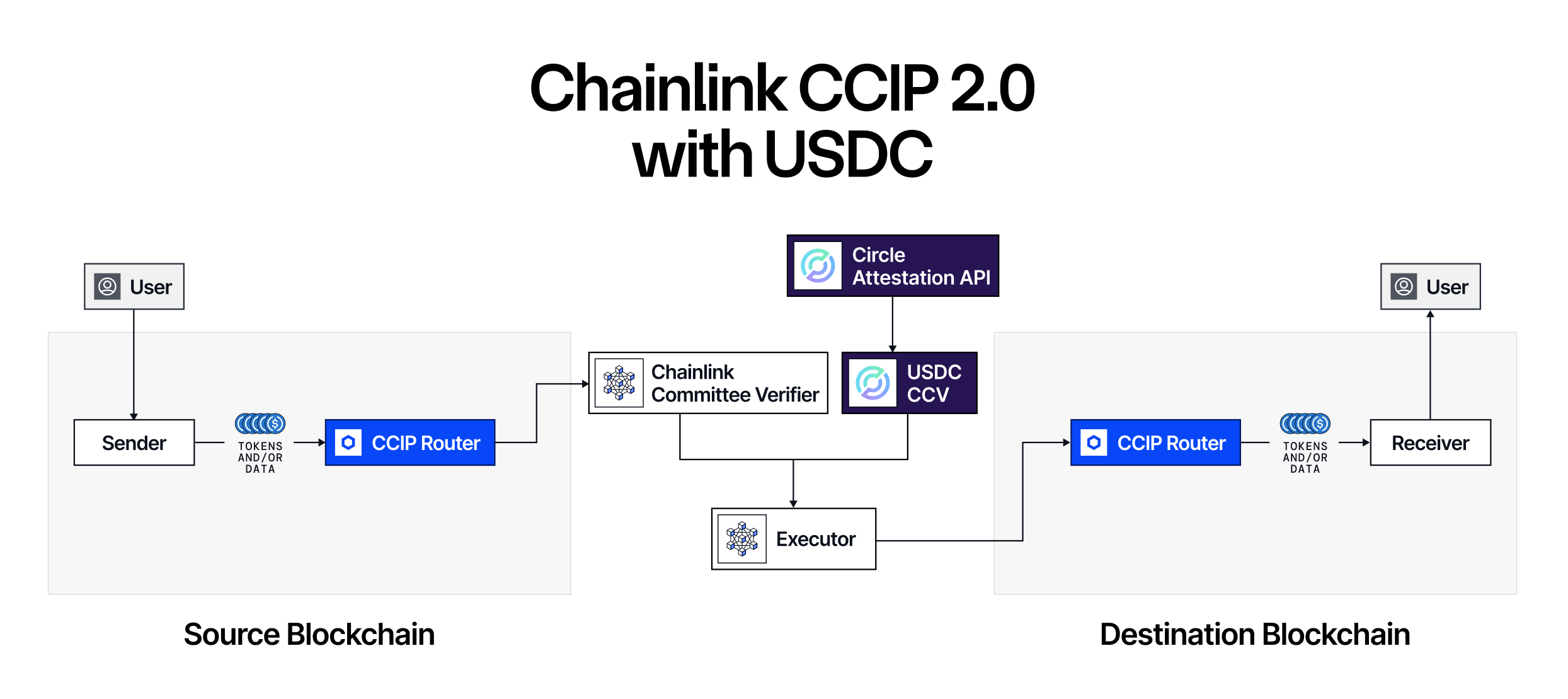
- Offchain, messages are verified by independent Cross-Chain Verifiers (CCVs). Every lane runs a default, decentralized Committee Verifier, and USDC transfers are additionally verified by a CCTP Verifier that checks Circle's own attestation for the burn.
- Once the required verifiers have attested, the message is delivered on the destination chain through the OffRamp, which verifies each attestation before the USDC token pool mints USDC using Circle's attestation.
- Execution on destination is permissionless, as in, anyone can submit an attested message for execution, and the Chainlink Executor does so by default.
- All lanes remain protected by the Risk Management Network, which can halt sends and executions on a lane through its cursing mechanism if a safety issue is detected.
The diagram below shows the native USDC flow: the USDC token pool burns tokens on the source chain via CCTP, the CCTP Verifier checks Circle's attestation for the burn, and the destination token pool mints USDC using that attestation once all required verifiers have signed off. To learn more about these components, read the [CCIP architecture overview](/ccip/concepts/architecture/overview).
## Before you begin
1. You should understand how to write, compile, deploy, and fund a smart contract. Go through this [tutorial](/quickstarts/deploy-your-first-contract) to get started.
2. Your account must have some `ETH` and `LINK` tokens on *Ethereum Sepolia*, and `ETH` on *Arbitrum Sepolia* for deploying the destination contracts and redeeming `STK`. Learn how to [Acquire testnet LINK](/resources/acquire-link).
3. Check the [CCIP Directory](/ccip/directory) if you want to configure a different set of source and destination chains/tokens.
4. Acquire USDC tokens from the [Circle faucet](https://faucet.circle.com/) on *Ethereum Sepolia*.
## Examine the code
Three contracts make this work, spread across two chains. \
`USDCSender` sits on *Ethereum Sepolia* and starts the transfer. On *Arbitrum Sepolia*, `USDCReceiver` catches the incoming message and hands the USDC to `USDCStaker`, which mints a receipt token to whoever the sender nominated.
#### 1. USDCSender (source chain)
1. **Constructor.** Three addresses are stored as immutables and never change afterwards: the CCIP router, LINK, and USDC.
2. **Receiver allowlist.** `s_receivers` maps a destination chain selector to the single receiver permitted on that chain. The owner manages entries through `setReceiverForDestinationChain` and `deleteReceiverForDestinationChain`. \
Sending to a chain with no entry reverts with `NoReceiverOnDestinationChain`, and a zero selector is rejected before anything else happens.
3. **The payload is a function call.** Most CCIP examples put arbitrary bytes in `data`. \
Here it carries an encoded call instead, and that is the idea the tutorial rests on:
```solidity filename="USDCSender.sol"
data: abi.encodeWithSelector(IStaker.stake.selector, _beneficiary, _amount)
```
4. **Token amounts.** An array with one entry holding USDC and the amount, since this contract only ever moves a single token.
5. **Fee quoting.** `getFee` is a helper on this contract, not the router's own function. \
It assembles the identical `EVM2AnyMessage` that `sendMessage` will build, then forwards it to the router, so both calls price exactly the same message. The only gap is fee drift between blocks, since `sendMessage` re-quotes when it runs.
6. **Sending, and where the tokens come from.** `sendMessage` is restricted to the owner, which is the account that deployed the contract. It pulls USDC from `msg.sender` using `transferFrom`, and pulls the fee token the same way when you pay in an ERC-20. \
You approve from your own wallet, so there is no need to move USDC into the sender contract beforehand. A zero amount reverts with `AmountIsZero`.
7. **`extraArgs` arrive pre built and encoded.** The contract accepts encoded bytes and passes them through untouched. Keeping that encoding offchain is what lets one contract serve both pre-2.0 and 2.0 lanes without a redeploy.
8. **Withdrawals.** `withdrawNativeToken`, `withdrawLinkToken`, and `withdrawUsdcToken` let the owner sweep out anything left behind, each reverting with `NothingToWithdraw` on an empty balance.
> **CAUTION: Best Practices**
>
> This example is simplified for educational purposes. For production code, follow these best practices:
>
> - **Keep extraArgs mutable**: In production, build extraArgs off-chain and pass them into your contract calls, or store them in a storage variable that can be updated. Never hardcode them. This keeps your contract compatible with future extraArgs versions and lets one deployment serve both pre-2.0 and CCIP 2.0 lanes without redeploying. See [Best Practices: Using extraArgs](/ccip/evm/concepts/best-practices#using-extraargs).
>
> - **Validate the destination chain**: Always ensure the destination chain is valid and supported before sending messages. See [Verify destination chain](/ccip/evm/concepts/best-practices#verify-destination-chain).
>
> - **Use ExtraArgsV3 on CCIP 2.0 lanes**: New integrations should encode [ExtraArgsV3](/ccip/evm/api-reference/v2.0.0/extra-args-codec), which carries the gas limit, requested finality, Cross-Chain Verifiers (CCVs), and executor settings (*More on `ExtraArgsV3` below*)
>
> - Legacy [GenericExtraArgsV2](/ccip/evm/api-reference/v2.0.0/client#genericextraargsv2) arguments are still accepted, but only the gasLimit field is honored. allowOutOfOrderExecution is deprecated in v2.0.
>
> - **Understand CCIP Service Limits**: Review the [CCIP Service Limits](/ccip/evm/service-limits) for constraints on message data size, execution gas, and the number of tokens per transaction. If your requirements exceed these limits, you may need to [contact the Chainlink Labs Team](https://chain.link/ccip-contact).
[USDCSender.sol](https://github.com/smartcontractkit/docs-ccip/blob/main/contracts/tutorials/transfer-usdc-with-data/USDCSender.sol)
View the complete contract on GitHub.
#### 2. USDCStaker (destination chain)
1. **It is an ERC-20 in its own right.** Staking mints a receipt token named `Simple Staker`, with the symbol `STK`.
2. **Decimals follow USDC.** The constructor reads `decimals()` off the USDC contract and mirrors it, so `STK` also uses 6 decimals and balances line up 1:1 with the USDC backing them. A zero reverts with `InvalidNumberOfDecimals`.
3. **`stake(beneficiary, amount)`.** Pulls USDC from the caller, then mints an equal amount of `STK` to the beneficiary. Those are deliberately two different addresses. Guards cover a zero beneficiary and a zero amount.
4. **`redeem()`.** Burns the caller's entire `STK` balance and sends back the same amount of USDC. Since it works off `msg.sender`, only the beneficiary can redeem their own position.
[USDCStaker.sol](https://github.com/smartcontractkit/docs-ccip/blob/main/contracts/tutorials/transfer-usdc-with-data/USDCStaker.sol)
View the complete contract on GitHub.
#### 3. USDCReceiver (destination chain)
1. **Constructor.** Extends `CCIPReceiver` with the router address and stores USDC and the staker as immutables. It also grants the staker an unlimited USDC allowance up front, which is why staking needs no per message approval later on.
2. **Sender allowlist.** The mirror image of the sender's list. `s_senders` maps a source chain selector to the one sender allowed to reach this contract. A message from an unlisted chain, or from the wrong address on a listed one, reverts with `WrongSenderForSourceChain`.
3. **Finality policy.** `setAllowedFinalityConfig` stores a `bytes4` per source chain, and `getCCVsAndFinalityConfig` is what the OffRamp reads back when a message lands. Left at `bytes4(0)`, the contract accepts fully finalized messages only. A non-zero value opts into faster delivery by declaring the shallowest block depth this contract is willing to trust. The configure step later sets it to 32.
4. **Failures are caught, not thrown.** `ccipReceive` wraps the real work in a `try` block:
```solidity filename="USDCReceiver.sol"
try this.processMessage(any2EvmMessage) {}
catch (bytes memory err) {
s_failedMessages.set(any2EvmMessage.messageId, uint256(ErrorCode.FAILED));
s_messageContents[any2EvmMessage.messageId] = any2EvmMessage;
emit MessageFailed(any2EvmMessage.messageId, err);
return;
}
```
Swallowing the revert keeps the CCIP execution itself successful, so the tokens settle in this contract rather than being stranded mid transfer. `processMessage` is external purely so the `try` is possible at all, and `onlySelf` keeps anyone else from calling it.
5. **Processing a message.** `_ccipReceive` first checks that the arriving token matches the USDC the contract was deployed against, rejecting anything else with `WrongReceivedToken`. It then decodes the beneficiary from the payload and calls `stake()` with `destTokenAmounts[0].amount`, the amount that actually landed, rather than the figure the sender encoded. That distinction matters, because CCTP can take a fee on the destination side, so only the arriving balance is reliable.
6. **Inspecting and recovering failures.** `getFailedMessages` returns a paginated view backed by an `EnumerableMap`. `retryFailedMessage` lets the owner mark a message `RESOLVED`, which blocks replays, and move the tokens to an address of their choosing. It reads the token out of the stored message rather than the immutable, so recovery still works for something unexpected. Neither runs on the happy path, but they are what makes a failed delivery recoverable.
[USDCReceiver.sol](https://github.com/smartcontractkit/docs-ccip/blob/main/contracts/tutorials/transfer-usdc-with-data/USDCReceiver.sol)
View the complete contract on GitHub.
## Tutorial
Let's get started! Choose your preferred development environment below.
### Foundry
Best for **Solidity-native** workflows that prefer a modular, powerful scripting framework.
> **NOTE: Want to set up a dev environment from scratch? **
>
> Check out the [Getting started page](/ccip/evm/getting-started#foundry) for detailed instructions on setting up a
> Foundry dev environment from scratch.
#### 1. Bootstrap a new Foundry project
[CCIP 2.0 template](https://github.com/smartcontractkit/docs-ccip)
Clone the template for a smoother setup.
1. Clone the [CCIP 2.0 template](https://github.com/smartcontractkit/docs-ccip) repository, and open a terminal inside the project directory:
```bash filename="Terminal"
git clone https://github.com/smartcontractkit/docs-ccip.git && cd docs-ccip
```
2. If you don't already have a Foundry keystore, create one with `cast`. Here, `your_keystore_name` is the alias you assign to this entry, and Foundry will prompt you for the private key itself along with a password to encrypt it:
```bash filename="Terminal"
cast wallet import your_keystore_name --interactive
```
> **CAUTION: Note**
>
> As of writing, Foundry supports keystore encryption only for private keys (not generic strings), so in this tutorial
> we only encrypt the private key and store the keystore alias in `KEYSTORE_NAME`.
3. Install dependencies:
```bash filename="Terminal"
npm install
```
4. Create a `.env` file by copying the example file, and fill in your values:
```bash filename="Terminal"
cp .env.example .env
```
Set `KEYSTORE_NAME` to the entry you just created, and provide RPC endpoints for both chains on this lane:
```env filename=".env"
# Keystore name
KEYSTORE_NAME=your_keystore_name
# RPC URLs
ETHEREUM_SEPOLIA_RPC_URL=
ARBITRUM_SEPOLIA_RPC_URL=
# Etherscan API key (not used in this tutorial)
ETHERSCAN_API_KEY=
```
5. Load the environment variables:
```bash filename="Terminal"
source .env
```
6. Compile the contracts:
```bash filename="Terminal"
forge build
```
#### 2. Deploy your contracts
`Deploy.s.sol` handles all three deployments across both chains in a single run:
- Deploy `USDCSender` on *Ethereum Sepolia* (source).
- Deploy `USDCStaker` on *Arbitrum Sepolia* (destination).
- Deploy `USDCReceiver` on *Arbitrum Sepolia* (destination), wired to the staker it just deployed.
- Print all three addresses in the terminal.
To run the script, use the following command:
```bash filename="Terminal"
SOURCE_CHAIN=ETHEREUM_SEPOLIA DEST_CHAIN=ARBITRUM_SEPOLIA \
forge script foundry/scripts/tutorials/transfer-usdc-with-data/deploy/Deploy.s.sol:Deploy \
--account $KEYSTORE_NAME \
--broadcast -vv
```
Your terminal should look something like this:
```bash filename="Terminal"
========================================
🚀 Deploy USDC Transfer-with-Data Contracts
========================================
Source Chain: Ethereum Sepolia
Destination Chain: Arbitrum Sepolia
========================================
[Step 1] Deploying USDCSender on Ethereum Sepolia
router: 0x0BF3dE8c5D3e8A2B34D2BEeB17ABfCeBaf363A59
link: 0x779877A7B0D9E8603169DdbD7836e478b4624789
usdc: 0x1c7D4B196Cb0C7B01d743Fbc6116a902379C7238
Contract deployed at: 0x7A9c4E1b2D3f5061A2b3C4d5E6f708192a3B4c5D
https://sepolia.etherscan.io/address/0x7A9c4E1b2D3f5061A2b3C4d5E6f708192a3B4c5D
========================================
✅ USDCSender deployed on Ethereum Sepolia!
========================================
[Step 2] Deploying USDCStaker on Arbitrum Sepolia
usdc: 0x75faf114eafb1BDbe2F0316DF893fd58CE46AA4d
Contract deployed at: 0x2F8b1D4e5A6c7089B1c2D3e4F5a6B7c8D9e0F1a2
https://sepolia.arbiscan.io/address/0x2F8b1D4e5A6c7089B1c2D3e4F5a6B7c8D9e0F1a2
[Step 3] Deploying USDCReceiver on Arbitrum Sepolia
router: 0x2a9C5afB0d0e4BAb2BCdaE109EC4b0c4Be15a165
usdc: 0x75faf114eafb1BDbe2F0316DF893fd58CE46AA4d
staker: 0x2F8b1D4e5A6c7089B1c2D3e4F5a6B7c8D9e0F1a2
Contract deployed at: 0x9B0c1D2e3F4a5B6c7D8e9F0a1B2c3D4e5F6a7B8c
https://sepolia.arbiscan.io/address/0x9B0c1D2e3F4a5B6c7D8e9F0a1B2c3D4e5F6a7B8c
========================================
✅ USDCStaker + USDCReceiver deployed on Arbitrum Sepolia!
========================================
========================================
✅ All Deployments Complete!
========================================
Source Chain: Ethereum Sepolia
USDCSender: 0x7A9c4E1b2D3f5061A2b3C4d5E6f708192a3B4c5D
https://sepolia.etherscan.io/address/0x7A9c4E1b2D3f5061A2b3C4d5E6f708192a3B4c5D
Destination Chain: Arbitrum Sepolia
USDCStaker: 0x2F8b1D4e5A6c7089B1c2D3e4F5a6B7c8D9e0F1a2
https://sepolia.arbiscan.io/address/0x2F8b1D4e5A6c7089B1c2D3e4F5a6B7c8D9e0F1a2
USDCReceiver: 0x9B0c1D2e3F4a5B6c7D8e9F0a1B2c3D4e5F6a7B8c
https://sepolia.arbiscan.io/address/0x9B0c1D2e3F4a5B6c7D8e9F0a1B2c3D4e5F6a7B8c
Run this command to set all environment variables:
export ETHEREUM_SEPOLIA_CONTRACT=0x7A9c4E1b2D3f5061A2b3C4d5E6f708192a3B4c5D && export ARBITRUM_SEPOLIA_STAKER_CONTRACT=0x2F8b1D4e5A6c7089B1c2D3e4F5a6B7c8D9e0F1a2 && export ARBITRUM_SEPOLIA_CONTRACT=0x9B0c1D2e3F4a5B6c7D8e9F0a1B2c3D4e5F6a7B8c
========================================
```
2. Export the three addresses the remaining steps rely on:
```bash filename="Terminal"
export ETHEREUM_SEPOLIA_CONTRACT= && export ARBITRUM_SEPOLIA_STAKER_CONTRACT= && export ARBITRUM_SEPOLIA_CONTRACT=
```
`ARBITRUM_SEPOLIA_STAKER_CONTRACT` is used later when you redeem `STK` for USDC.
[Deploy.s.sol](https://github.com/smartcontractkit/docs-ccip/blob/main/foundry/scripts/tutorials/transfer-usdc-with-data/deploy/Deploy.s.sol)
View the complete script on GitHub.
#### 3. Configure allowlists and finality
The sender and receiver start out refusing this lane. `Configure.s.sol` introduces them to each other and sets the finality policy in one run:
- On *Ethereum Sepolia*, call `setReceiverForDestinationChain` on `USDCSender` to allowlist the *Arbitrum Sepolia* receiver.
- On *Arbitrum Sepolia*, call `setSenderForSourceChain` on `USDCReceiver` to allowlist the *Ethereum Sepolia* sender.
- On *Arbitrum Sepolia*, call `setAllowedFinalityConfig` so the receiver will accept custom finality.
##### Finality configuration
> **NOTE: Faster Than Finality (FTF)**
>
> By default, CCIP waits for a message's source-chain transaction to reach **full finality** (the point where the chain guarantees it can no longer be reverted) before the message is verified and executed on the destination chain.
>
> CCIP 2.0 lanes also support **Faster-Than-Finality (FTF)**, an opt-in mode where the sender requests that the message be processed once the source chain has reached a chosen level of assurance *short of* full finality.
>
> The finality setting is expressed in one of two ways, and a sender can choose **exactly one** mode per message:
>
> - **By name (a string):** `Finalized` requests full finality. This is the default. Omit it and CCIP waits for full finality. Other named modes are reserved in the encoding for future protocol use; none are activated on lanes today.
> - **By numeric block depth:** a number from 1 to 65,535 that tells CCIP to wait until N blocks have been built on top of the transaction's block. These tutorials use a minimum block depth of **32**.
>
> Receivers, token pools, and Cross-Chain Verifiers do not request finality; they configure which modes they **allow**. Every gate along the message path must permit the request:
>
> - **Token pool** (token transfers): Validates the request at send time. A request the pool does not permit reverts `ccipSend`, and nothing is sent.
> - **Cross-Chain Verifiers:** Each required verifier attests only messages whose requested finality it permits.
> - **Receiver** (messages that call `ccipReceive`): The receiver's allowed finality is checked at delivery. A mismatch fails execution.
>
> Read more in [Understanding Faster-Than-Finality (FTF) transfers](/ccip/concepts/execution-latency/ftf).
`ALLOWED_FINALITY_CONFIG=BLOCK_DEPTH` paired with `ALLOWED_BLOCK_DEPTH=32` sets the receiver's minimum accepted block depth to 32. Omit `ALLOWED_FINALITY_CONFIG` to leave the receiver at the default: full finality only.
When the pool exposes a minimum, the script checks your value against it before broadcasting, so a depth the lane will not honor fails immediately instead of much later, as a rejected message.
```bash filename="Terminal"
SOURCE_CHAIN=ETHEREUM_SEPOLIA DEST_CHAIN=ARBITRUM_SEPOLIA \
ALLOWED_FINALITY_CONFIG=BLOCK_DEPTH \
ALLOWED_BLOCK_DEPTH=32 \
forge script foundry/scripts/tutorials/transfer-usdc-with-data/configure/Configure.s.sol:Configure \
--account $KEYSTORE_NAME \
--broadcast -vv
```
Your terminal should look something like this:
```bash filename="Terminal"
========================================
⚙️ Configure USDC Transfer-with-Data Contracts
========================================
Source Chain: Ethereum Sepolia
USDCSender: 0x7A9c4E1b2D3f5061A2b3C4d5E6f708192a3B4c5D
Destination Chain: Arbitrum Sepolia
USDCReceiver: 0x9B0c1D2e3F4a5B6c7D8e9F0a1B2c3D4e5F6a7B8c
========================================
[Step 1] Setting receiver on USDCSender (Ethereum Sepolia)
Destination chain: Arbitrum Sepolia (selector: 3478487238524512106)
Receiver address: 0x9B0c1D2e3F4a5B6c7D8e9F0a1B2c3D4e5F6a7B8c
✅ Receiver set for destination chain
========================================
✅ Configuration Complete on Ethereum Sepolia!
========================================
[Step 2] Configuring USDCReceiver (Arbitrum Sepolia)
Source chain: Ethereum Sepolia (selector: 16015286601757825753)
Sender address: 0x7A9c4E1b2D3f5061A2b3C4d5E6f708192a3B4c5D
✅ Sender set for source chain
Setting allowed finality config to 0x00000020 (BLOCK_DEPTH=32)...
✅ Allowed finality config set to 0x00000020 (BLOCK_DEPTH=32) for Ethereum Sepolia
========================================
✅ Configuration Complete on Arbitrum Sepolia!
========================================
========================================
✅ All Configurations Complete!
========================================
USDCSender on Ethereum Sepolia is configured to send USDC to Arbitrum Sepolia
USDCReceiver on Arbitrum Sepolia is configured to accept messages from Ethereum Sepolia
** Next Step: Send USDC with Data **
========================================
```
The script closes by printing ready-to-run send commands for both LINK and native fees. The next step covers the LINK version.
[Configure.s.sol](https://github.com/smartcontractkit/docs-ccip/blob/main/foundry/scripts/tutorials/transfer-usdc-with-data/configure/Configure.s.sol)
View the complete script on GitHub.
#### 4. Send USDC with data
`SendMessage.s.sol` carries out the transfer end to end:
- Builds `extraArgs` offchain through `ExtraArgsHelper.buildExtraArgs`, which reads the USDC token pool's allowed finality config, falling back to a `router.getFee` probe when the pool exposes none, then encodes V2 or V3 to match the lane.
- Quotes the CCIP fee through the sender's `getFee`.
- Approves `USDCSender` to pull USDC and LINK from your wallet.
- Sends the message, then prints the message ID and a CCIP Explorer link.
##### Beneficiary
`BENEFICIARY` is the address that ends up holding the `STK` tokens on *Arbitrum Sepolia*. For this tutorial, use the same wallet that broadcasts the send transaction so the same keystore can redeem later.
Get that address from your Foundry keystore:
```bash filename="Terminal"
cast wallet address --account $KEYSTORE_NAME
```
Use the printed address in the `BENEFICIARY=` placeholder in the send command below.
> You can set `BENEFICIARY` to a different address, but only that address can later redeem the `STK` tokens for USDC. So only use an address whose private key you control, and make sure it has the native gas token on *Arbitrum Sepolia* to cover gas for the redeem step.
##### Faster Than Finality (block depth)
> **NOTE: ExtraArgsV3**
>
> On CCIP 2.0 EVM lanes, the `extraArgs` field of a CCIP message is encoded as **`ExtraArgsV3`**, which allow you to use CCIP 2.0 specific features. The tutorial scripts set two of its fields:
>
> - **`gasLimit`** (`uint32`): the gas made available to the receiver's `ccipReceive` callback on the destination chain. The sender is billed for the gas specified, not the gas actually used, and unspent gas is not refunded. A gas limit of zero combined with no message data skips the callback entirely, which is what you would want for pure token transfers or EOA receivers.
> - **`requestedFinalityConfig`** (`bytes4`): the finality the sender requests for this message, encoded with `FinalityCodec`. `0x00000000` requests `Finalized` (full finality, the default). A numeric block depth instead requests [faster-than-finality](/ccip/concepts/execution-latency/ftf) delivery.
> These tutorials use a depth of 32, which encodes as `0x00000020`.
>
> For the complete list of supported parameters, see the
>
> 1. [`ExtraArgsCodec`](/ccip/evm/api-reference/v2.0.0/extra-args-codec) API reference,
> 2. or the [`ExtraArgsCodec.sol`](https://github.com/smartcontractkit/chainlink-ccip/blob/main/chains/evm/contracts/libraries/ExtraArgsCodec.sol) source in the chainlink-ccip repository.
>
> On pre-2.0 lanes, the scripts fall back to legacy `GenericExtraArgsV2` extraArgs, where only the `gasLimit` field is honored.
The `BLOCK_DEPTH` variable controls the source-chain finality requested for CCIP execution:
- Omit it, or set `BLOCK_DEPTH=DEFAULT` or `BLOCK_DEPTH=0`, to request full finality.
- Set `BLOCK_DEPTH=32` to request faster delivery. This matches the `ALLOWED_BLOCK_DEPTH` you configured on the receiver in the previous step, so the two ends agree.
```bash filename="Terminal"
SOURCE_CHAIN=ETHEREUM_SEPOLIA DEST_CHAIN=ARBITRUM_SEPOLIA \
FEE_TOKEN=LINK \
BENEFICIARY= \
USDC_AMOUNT=1230000 \
BLOCK_DEPTH=32 \
forge script foundry/scripts/tutorials/transfer-usdc-with-data/interact/SendMessage.s.sol:SendMessage \
--account $KEYSTORE_NAME \
--broadcast -vv
```
`USDC_AMOUNT` is denominated in raw units, so `1230000` is 1.23 USDC at 6 decimals. That is not the script default, which is `1000000`.
Your terminal should look something like this:
```bash filename="Terminal"
========================================
📡 Send USDC with Data via CCIP - Pay with LINK
========================================
Source Chain: Ethereum Sepolia
Destination Chain: Arbitrum Sepolia
USDCSender: 0x7A9c4E1b2D3f5061A2b3C4d5E6f708192a3B4c5D
USDCReceiver: 0x9B0c1D2e3F4a5B6c7D8e9F0a1B2c3D4e5F6a7B8c
Beneficiary: 0x5C6d7E8f9A0b1C2d3E4f5A6b7C8d9E0f1A2b3C4d
USDC Amount: 1230000 (raw units)
Fee Token: LINK
========================================
[Pre-validation] Detecting lane version and building extraArgs...
Gas limit: 1000000
Token pool ALLOWED_FINALITY_CONFIG: undefined (pool has no constraint or pre-v2.0 pool).
V3 extraArgs accepted by lane (v2.0+ lane, no pool constraint).
Receiver contract ALLOWED_FINALITY_CONFIG: 0x00000020 (BLOCK_DEPTH: 32 block(s))
✅ Using V3 extraArgs with FTF (gasLimit=1000000, finalityConfig=0x00000020 (BLOCK_DEPTH: 32 block(s))).
Estimated CCIP fee: 21374829384756123
Extra args: 0xa69dd4aa000f42400000002000000000000000
[Step 1] Approving USDCSender to spend USDC...
USDC amount: 1230000
✅ Approved
[Step 2] Approving USDCSender to spend fee token for CCIP fees...
Fee: 21374829384756123
✅ Approved
[Step 3] Sending USDC with data via CCIP (ERC-20 fee)...
========================================
✅ CCIP Message Sent Successfully!
========================================
CCIP Message ID: 0x8f2a4b6c1d3e5f708192a3b4c5d6e7f8091a2b3c4d5e6f708192a3b4c5d6e7f8
CCIP Explorer:
https://ccip.chain.link/#/side-drawer/msg/0x8f2a4b6c1d3e5f708192a3b4c5d6e7f8091a2b3c4d5e6f708192a3b4c5d6e7f8
Once confirmed (status: Success), beneficiary 0x5C6d7E8f9A0b1C2d3E4f5A6b7C8d9E0f1A2b3C4d
will have STK tokens on Arbitrum Sepolia redeemable for USDC via the USDCStaker contract.
========================================
```
The next step redeems the `STK` tokens after the message settles and staking succeeds.
> **NOTE: Wait for the message to settle**
>
> Delivery takes a few minutes. Open the CCIP Explorer link from your terminal and wait for the status to read
> **Success** before checking the beneficiary's `STK` balance on the `USDCStaker` contract. If the redeem step still
> reports no `STK`, inspect failed messages on the receiver.
##### Environment variables
| Variable | Description | Default |
| ------------------------- | ------------------------------------------------------------------------------------------------- | --------- |
| `KEYSTORE_NAME` | Foundry keystore alias created with `cast wallet import` | Not set |
| `{CHAIN}_RPC_URL` | RPC endpoint per chain, for example `ETHEREUM_SEPOLIA_RPC_URL` | Not set |
| `SOURCE_CHAIN` | Source chain identifier, `ETHEREUM_SEPOLIA` on this lane | Not set |
| `DEST_CHAIN` | Destination chain identifier, `ARBITRUM_SEPOLIA` on this lane | Not set |
| `CHAIN` | Chain identifier for destination-chain scripts, `ARBITRUM_SEPOLIA` on this lane | Not set |
| `{CHAIN}_CONTRACT` | Deployed contract on that chain: the sender on the source, the receiver on the destination | Not set |
| `{CHAIN}_STAKER_CONTRACT` | Deployed `USDCStaker` contract on the destination, for example `ARBITRUM_SEPOLIA_STAKER_CONTRACT` | Not set |
| `FEE_TOKEN` | `LINK` or `NATIVE` | `NATIVE` |
| `FEE_TOKEN_ADDRESS` | Any CCIP-supported fee token on the lane. Takes priority over `FEE_TOKEN` | Not set |
| `BENEFICIARY` | Address that receives the `STK` tokens on the destination chain | Not set |
| `USDC_AMOUNT` | USDC to send, in raw units at 6 decimals | `1000000` |
| `GAS_LIMIT` | Gas made available to the receiver on the destination chain | `1000000` |
| `BLOCK_DEPTH` | Block depth requested on send. `DEFAULT` or `0` waits for full finality | `DEFAULT` |
| `WAIT_FOR_FINALITY` | Requests full finality explicitly. Equivalent to leaving `BLOCK_DEPTH` unset | `false` |
| `ALLOWED_FINALITY_CONFIG` | Finality modes the receiver will accept, set during configuration | Not set |
| `ALLOWED_BLOCK_DEPTH` | Shallowest block depth the receiver accepts. Required when `ALLOWED_FINALITY_CONFIG` uses it | Not set |
[SendMessage.s.sol](https://github.com/smartcontractkit/docs-ccip/blob/main/foundry/scripts/tutorials/transfer-usdc-with-data/interact/SendMessage.s.sol)
View the complete script on GitHub.
#### 5. Redeem STK for USDC
After the CCIP Explorer shows that the message has been successfully processed and the beneficiary has received `STK`, the beneficiary can redeem those tokens on *Arbitrum Sepolia*.
`Redeem.s.sol` checks the caller's `STK` balance, calls `redeem()` on `USDCStaker`, burns the caller's full `STK` balance, and transfers the same amount of USDC back to the caller.
> **CAUTION: Redeem from the beneficiary wallet**
>
> 1. `redeem()` uses `msg.sender`, so run this command with the same keystore that controls `BENEFICIARY`.
> 2. If you used a different beneficiary address, import that account into your Foundry keystore and run this step with
> that alias.
```bash filename="Terminal"
CHAIN=ARBITRUM_SEPOLIA \
forge script foundry/scripts/tutorials/transfer-usdc-with-data/interact/Redeem.s.sol:Redeem \
--account $KEYSTORE_NAME \
--broadcast -vv
```
Your terminal should look something like this:
```bash filename="Terminal"
========================================
💰 Redeem STK Tokens for USDC
========================================
Chain: Arbitrum Sepolia
USDCStaker: 0x2F8b1D4e5A6c7089B1c2D3e4F5a6B7c8D9e0F1a2
========================================
STK balance: 1230000
USDC to receive: 1230000 (raw units)
[Step 1] Calling redeem() on USDCStaker...
This burns your entire STK balance and returns the equivalent USDC.
========================================
✅ Redeem Complete!
========================================
USDC received: 1230000 (raw units)
USDC balance: 1230000 (raw units)
USDCStaker: 0x2F8b1D4e5A6c7089B1c2D3e4F5a6B7c8D9e0F1a2
https://sepolia.arbiscan.io/address/0x2F8b1D4e5A6c7089B1c2D3e4F5a6B7c8D9e0F1a2
========================================
```
Your final USDC balance may be higher if the wallet already held USDC before redeeming.
> **NOTE: Optional: inspect failed messages**
>
> 1. If delivery fails or `STK` was not minted, inspect failed messages on the receiver before redeeming. 2.
> `SendMessage.s.sol` prints commands for `GetFailedMessages.s.sol` and `RetryFailedMessage.s.sol` after each send. 3.
> `RetryFailedMessage.s.sol` recovers the received USDC from `USDCReceiver`; it does not mint `STK`.
[Redeem.s.sol](https://github.com/smartcontractkit/docs-ccip/blob/main/foundry/scripts/tutorials/transfer-usdc-with-data/interact/Redeem.s.sol)
View the complete script on GitHub.
### Hardhat
Best for developers who want a mature, TypeScript-based smart contract development framework.
> **NOTE: Want to set up a dev environment from scratch? **
>
> Check out the [Getting started page](/ccip/evm/getting-started#hardhat-3) for detailed instructions on setting up a
> Hardhat dev environment from scratch.
#### 1. Bootstrap a new Hardhat project
[CCIP 2.0 template](https://github.com/smartcontractkit/docs-ccip)
Clone the template (contains both Hardhat and Foundry code) for a smoother setup.
1. Clone the [CCIP 2.0 template](https://github.com/smartcontractkit/docs-ccip) repository, and open a terminal inside the project directory:
```bash filename="Terminal"
git clone https://github.com/smartcontractkit/docs-ccip.git && cd docs-ccip
```
2. Copy the example environment file and fill in your values:
```bash filename="Terminal"
cp .env.example .env
```
Set `KEYSTORE_NAME` to the keystore alias you will create later in this section, and provide RPC endpoints for both chains on this lane:
```env filename=".env"
# Keystore name
KEYSTORE_NAME=your_keystore_name
# RPC URLs
ETHEREUM_SEPOLIA_RPC_URL=
ARBITRUM_SEPOLIA_RPC_URL=
# Etherscan API key (not used in this tutorial)
ETHERSCAN_API_KEY=
```
3. Install dependencies and compile:
```bash filename="Terminal"
npm install && npx hardhat compile
```
4. Load the environment variables:
```bash filename="Terminal"
source .env
```
> **CAUTION: Run this in every new terminal session**
>
> If you open a new terminal, you must run `source .env` again. To verify, run `echo $ETHEREUM_SEPOLIA_RPC_URL` and
> confirm it prints your URL.
5. Create a Hardhat keystore entry for your private key. Use the same name as `KEYSTORE_NAME` in your `.env` file. Hardhat will prompt you to enter the private key and a password to encrypt it:
```bash filename="Terminal"
npx hardhat keystore set your_keystore_name
```
#### 2. Deploy your contracts
`deploy.ts` handles all three deployments across both chains in a single run:
- Deploy `USDCSender` on *Ethereum Sepolia* (source).
- Deploy `USDCStaker` on *Arbitrum Sepolia* (destination).
- Deploy `USDCReceiver` on *Arbitrum Sepolia* (destination), wired to the staker it just deployed.
- Print all three addresses in the terminal.
To run the script, use the following command:
```bash filename="Terminal"
SOURCE_CHAIN=ETHEREUM_SEPOLIA DEST_CHAIN=ARBITRUM_SEPOLIA \
npx hardhat run hardhat/scripts/tutorials/transfer-usdc-with-data/deploy/deploy.ts
```
Your terminal should look something like this:
```bash filename="Terminal"
========================================
🚀 Deploy USDC Transfer-with-Data Contracts
========================================
Source Chain: Ethereum Sepolia
Destination Chain: Arbitrum Sepolia
========================================
[Step 1] Deploying USDCSender on Ethereum Sepolia
router: 0x0BF3dE8c5D3e8A2B34D2BEeB17ABfCeBaf363A59
link: 0x779877A7B0D9E8603169DdbD7836e478b4624789
usdc: 0x1c7D4B196Cb0C7B01d743Fbc6116a902379C7238
Contract deployed at: 0x7A9c4E1b2D3f5061A2b3C4d5E6f708192a3B4c5D
https://sepolia.etherscan.io/address/0x7A9c4E1b2D3f5061A2b3C4d5E6f708192a3B4c5D
========================================
✅ USDCSender deployed on Ethereum Sepolia!
========================================
[Step 2] Deploying USDCStaker on Arbitrum Sepolia
usdc: 0x75faf114eafb1BDbe2F0316DF893fd58CE46AA4d
Contract deployed at: 0x2F8b1D4e5A6c7089B1c2D3e4F5a6B7c8D9e0F1a2
https://sepolia.arbiscan.io/address/0x2F8b1D4e5A6c7089B1c2D3e4F5a6B7c8D9e0F1a2
[Step 3] Deploying USDCReceiver on Arbitrum Sepolia
router: 0x2a9C5afB0d0e4BAb2BCdaE109EC4b0c4Be15a165
usdc: 0x75faf114eafb1BDbe2F0316DF893fd58CE46AA4d
staker: 0x2F8b1D4e5A6c7089B1c2D3e4F5a6B7c8D9e0F1a2
Contract deployed at: 0x9B0c1D2e3F4a5B6c7D8e9F0a1B2c3D4e5F6a7B8c
https://sepolia.arbiscan.io/address/0x9B0c1D2e3F4a5B6c7D8e9F0a1B2c3D4e5F6a7B8c
========================================
✅ USDCStaker + USDCReceiver deployed on Arbitrum Sepolia!
========================================
========================================
✅ All Deployments Complete!
========================================
Source Chain: Ethereum Sepolia
USDCSender: 0x7A9c4E1b2D3f5061A2b3C4d5E6f708192a3B4c5D
https://sepolia.etherscan.io/address/0x7A9c4E1b2D3f5061A2b3C4d5E6f708192a3B4c5D
Destination Chain: Arbitrum Sepolia
USDCStaker: 0x2F8b1D4e5A6c7089B1c2D3e4F5a6B7c8D9e0F1a2
https://sepolia.arbiscan.io/address/0x2F8b1D4e5A6c7089B1c2D3e4F5a6B7c8D9e0F1a2
USDCReceiver: 0x9B0c1D2e3F4a5B6c7D8e9F0a1B2c3D4e5F6a7B8c
https://sepolia.arbiscan.io/address/0x9B0c1D2e3F4a5B6c7D8e9F0a1B2c3D4e5F6a7B8c
Run this command to set all environment variables:
export ETHEREUM_SEPOLIA_CONTRACT=0x7A9c4E1b2D3f5061A2b3C4d5E6f708192a3B4c5D && export ARBITRUM_SEPOLIA_STAKER_CONTRACT=0x2F8b1D4e5A6c7089B1c2D3e4F5a6B7c8D9e0F1a2 && export ARBITRUM_SEPOLIA_CONTRACT=0x9B0c1D2e3F4a5B6c7D8e9F0a1B2c3D4e5F6a7B8c
========================================
```
2. Export the three addresses the remaining steps rely on:
```bash filename="Terminal"
export ETHEREUM_SEPOLIA_CONTRACT= && export ARBITRUM_SEPOLIA_STAKER_CONTRACT= && export ARBITRUM_SEPOLIA_CONTRACT=
```
`ARBITRUM_SEPOLIA_STAKER_CONTRACT` is used later when you redeem `STK` for USDC.
[deploy.ts](https://github.com/smartcontractkit/docs-ccip/blob/main/hardhat/scripts/tutorials/transfer-usdc-with-data/deploy/deploy.ts)
View the complete script on GitHub.
#### 3. Configure allowlists and finality
The sender and receiver start out refusing this lane. `configure.ts` introduces them to each other and sets the finality policy in one run:
- On *Ethereum Sepolia*, call `setReceiverForDestinationChain` on `USDCSender` to allowlist the *Arbitrum Sepolia* receiver.
- On *Arbitrum Sepolia*, call `setSenderForSourceChain` on `USDCReceiver` to allowlist the *Ethereum Sepolia* sender.
- On *Arbitrum Sepolia*, call `setAllowedFinalityConfig` so the receiver will accept custom finality.
##### Finality configuration
> **NOTE: Faster Than Finality (FTF)**
>
> By default, CCIP waits for a message's source-chain transaction to reach **full finality** (the point where the chain guarantees it can no longer be reverted) before the message is verified and executed on the destination chain.
>
> CCIP 2.0 lanes also support **Faster-Than-Finality (FTF)**, an opt-in mode where the sender requests that the message be processed once the source chain has reached a chosen level of assurance *short of* full finality.
>
> The finality setting is expressed in one of two ways, and a sender can choose **exactly one** mode per message:
>
> - **By name (a string):** `Finalized` requests full finality. This is the default. Omit it and CCIP waits for full finality. Other named modes are reserved in the encoding for future protocol use; none are activated on lanes today.
> - **By numeric block depth:** a number from 1 to 65,535 that tells CCIP to wait until N blocks have been built on top of the transaction's block. These tutorials use a minimum block depth of **32**.
>
> Receivers, token pools, and Cross-Chain Verifiers do not request finality; they configure which modes they **allow**. Every gate along the message path must permit the request:
>
> - **Token pool** (token transfers): Validates the request at send time. A request the pool does not permit reverts `ccipSend`, and nothing is sent.
> - **Cross-Chain Verifiers:** Each required verifier attests only messages whose requested finality it permits.
> - **Receiver** (messages that call `ccipReceive`): The receiver's allowed finality is checked at delivery. A mismatch fails execution.
>
> Read more in [Understanding Faster-Than-Finality (FTF) transfers](/ccip/concepts/execution-latency/ftf).
`ALLOWED_FINALITY_CONFIG=BLOCK_DEPTH` paired with `ALLOWED_BLOCK_DEPTH=32` sets the receiver's minimum accepted block depth to 32. Omit `ALLOWED_FINALITY_CONFIG` to leave the receiver at the default: full finality only.
When the pool exposes a minimum, the script checks your value against it before broadcasting, so a depth the lane will not honor fails immediately instead of much later, as a rejected message.
```bash filename="Terminal"
SOURCE_CHAIN=ETHEREUM_SEPOLIA DEST_CHAIN=ARBITRUM_SEPOLIA \
ALLOWED_FINALITY_CONFIG=BLOCK_DEPTH \
ALLOWED_BLOCK_DEPTH=32 \
npx hardhat run hardhat/scripts/tutorials/transfer-usdc-with-data/configure/configure.ts
```
Your terminal should look something like this:
```bash filename="Terminal"
========================================
⚙️ Configure USDC Transfer-with-Data Contracts
========================================
Source Chain: Ethereum Sepolia
USDCSender: 0x7A9c4E1b2D3f5061A2b3C4d5E6f708192a3B4c5D
Destination Chain: Arbitrum Sepolia
USDCReceiver: 0x9B0c1D2e3F4a5B6c7D8e9F0a1B2c3D4e5F6a7B8c
========================================
[Step 1] Setting receiver on USDCSender (Ethereum Sepolia)
Destination: Arbitrum Sepolia (selector: 3478487238524512106)
Receiver: 0x9B0c1D2e3F4a5B6c7D8e9F0a1B2c3D4e5F6a7B8c
✅ Receiver set for destination chain
========================================
✅ Configuration Complete on Ethereum Sepolia!
========================================
[Step 2] Configuring USDCReceiver (Arbitrum Sepolia)
Source: Ethereum Sepolia (selector: 16015286601757825753)
Sender: 0x7A9c4E1b2D3f5061A2b3C4d5E6f708192a3B4c5D
✅ Sender set for source chain
Setting allowed finality config to 0x00000020 (BLOCK_DEPTH=32)...
✅ Allowed finality config set to 0x00000020 (BLOCK_DEPTH=32) for Ethereum Sepolia
========================================
✅ Configuration Complete on Arbitrum Sepolia!
========================================
========================================
✅ All Configurations Complete!
========================================
USDCSender on Ethereum Sepolia is configured to send USDC to Arbitrum Sepolia
USDCReceiver on Arbitrum Sepolia is configured to accept messages from Ethereum Sepolia
** Next Step: Send USDC with Data **
========================================
```
The script closes by printing ready-to-run send commands for both LINK and native fees. The next step covers the LINK version.
[configure.ts](https://github.com/smartcontractkit/docs-ccip/blob/main/hardhat/scripts/tutorials/transfer-usdc-with-data/configure/configure.ts)
View the complete script on GitHub.
#### 4. Send USDC with data
`send-message.ts` carries out the transfer end to end:
- Builds `extraArgs` offchain through the shared `buildExtraArgs` helper, which queries lane features through `@chainlink/ccip-sdk`, validates the requested finality against the USDC token pool's and the receiver's allowed finality configs, then encodes V2 or V3 to match the lane.
- Quotes the CCIP fee through the sender's `getFee`.
- Approves `USDCSender` to pull USDC and LINK from your wallet.
- Sends the message, then prints the message ID and a CCIP Explorer link.
##### Beneficiary
`BENEFICIARY` is the address that ends up holding the `STK` tokens on *Arbitrum Sepolia*. For this tutorial, use the same wallet that broadcasts the send transaction so the same keystore can redeem later.
Get that address from your keystore:
```bash filename="Terminal"
cast wallet address --account $KEYSTORE_NAME
```
Use the printed address in the `BENEFICIARY=` placeholder in the send command below.
> You can set `BENEFICIARY` to a different address, but only that address can later redeem the `STK` tokens for USDC. So only use an address whose private key you control, and make sure it has the native gas token on *Arbitrum Sepolia* to cover gas for the redeem step.
##### Faster Than Finality (block depth)
> **NOTE: ExtraArgsV3**
>
> On CCIP 2.0 EVM lanes, the `extraArgs` field of a CCIP message is encoded as **`ExtraArgsV3`**, which allow you to use CCIP 2.0 specific features. The tutorial scripts set two of its fields:
>
> - **`gasLimit`** (`uint32`): the gas made available to the receiver's `ccipReceive` callback on the destination chain. The sender is billed for the gas specified, not the gas actually used, and unspent gas is not refunded. A gas limit of zero combined with no message data skips the callback entirely, which is what you would want for pure token transfers or EOA receivers.
> - **`requestedFinalityConfig`** (`bytes4`): the finality the sender requests for this message, encoded with `FinalityCodec`. `0x00000000` requests `Finalized` (full finality, the default). A numeric block depth instead requests [faster-than-finality](/ccip/concepts/execution-latency/ftf) delivery.
> These tutorials use a depth of 32, which encodes as `0x00000020`.
>
> For the complete list of supported parameters, see the
>
> 1. [`ExtraArgsCodec`](/ccip/evm/api-reference/v2.0.0/extra-args-codec) API reference,
> 2. or the [`ExtraArgsCodec.sol`](https://github.com/smartcontractkit/chainlink-ccip/blob/main/chains/evm/contracts/libraries/ExtraArgsCodec.sol) source in the chainlink-ccip repository.
>
> On pre-2.0 lanes, the scripts fall back to legacy `GenericExtraArgsV2` extraArgs, where only the `gasLimit` field is honored.
The `BLOCK_DEPTH` variable controls the source-chain finality requested for CCIP execution:
- Omit it, or set `BLOCK_DEPTH=DEFAULT` or `BLOCK_DEPTH=0`, to request full finality.
- Set `BLOCK_DEPTH=32` to request faster delivery. This matches the `ALLOWED_BLOCK_DEPTH` you configured on the receiver in the previous step, so the two ends agree.
```bash filename="Terminal"
SOURCE_CHAIN=ETHEREUM_SEPOLIA DEST_CHAIN=ARBITRUM_SEPOLIA \
FEE_TOKEN=LINK \
BENEFICIARY= \
USDC_AMOUNT=1230000 \
BLOCK_DEPTH=32 \
npx hardhat run hardhat/scripts/tutorials/transfer-usdc-with-data/interact/send-message.ts
```
`USDC_AMOUNT` is denominated in raw units, so `1230000` is 1.23 USDC at 6 decimals. That is not the script default, which is `1000000`.
Your terminal should look something like this:
```bash filename="Terminal"
========================================
📡 Send USDC with Data via CCIP - Pay with LINK
========================================
Source Chain: Ethereum Sepolia
Destination Chain: Arbitrum Sepolia
USDCSender: 0x7A9c4E1b2D3f5061A2b3C4d5E6f708192a3B4c5D
USDCReceiver: 0x9B0c1D2e3F4a5B6c7D8e9F0a1B2c3D4e5F6a7B8c
Beneficiary: 0x5C6d7E8f9A0b1C2d3E4f5A6b7C8d9E0f1A2b3C4d
USDC Amount: 1230000 (raw units)
Fee Token: LINK
========================================
[Pre-validation] Detecting lane version and building extraArgs...
Gas limit: 1000000
Token pool ALLOWED_FINALITY_CONFIG: 0x00000001 (BLOCK_DEPTH: 1 block(s))
Receiver contract ALLOWED_FINALITY_CONFIG: 0x00000020 (BLOCK_DEPTH: 32 block(s))
✅ Using V3 extraArgs with FTF (gasLimit=1000000, finalityConfig=32 block(s)).
[Pre-validation] CCIP fee: 21374829384756123
[Step 1] Approving USDCSender to spend USDC: 1230000...
✅ Approved
[Step 2] Approving USDCSender to spend LINK for CCIP fee: 21374829384756123...
✅ Approved
[Step 3] Sending USDC with data via CCIP (LINK fee)...
Required CCIP fee (in LINK units): 21374829384756123
========================================
✅ USDC sent successfully via CCIP!
========================================
CCIP messageId: 0x8f2a4b6c1d3e5f708192a3b4c5d6e7f8091a2b3c4d5e6f708192a3b4c5d6e7f8
CCIP Explorer:
https://ccip.chain.link/#/side-drawer/msg/0x8f2a4b6c1d3e5f708192a3b4c5d6e7f8091a2b3c4d5e6f708192a3b4c5d6e7f8
Once confirmed (status: Success), beneficiary 0x5C6d7E8f9A0b1C2d3E4f5A6b7C8d9E0f1A2b3C4d
will have STK tokens on Arbitrum Sepolia redeemable for USDC via the USDCStaker contract.
========================================
```
The next step redeems the `STK` tokens after the message settles and staking succeeds.
> **NOTE: Wait for the message to settle**
>
> Delivery takes a few minutes. Open the CCIP Explorer link from your terminal and wait for the status to read
> **Success** before checking the beneficiary's `STK` balance on the `USDCStaker` contract. If the redeem step still
> reports no `STK`, inspect failed messages on the receiver.
##### Environment variables
| Variable | Description | Default |
| ------------------------- | ------------------------------------------------------------------------------------------------- | -------------------- |
| `KEYSTORE_NAME` | Hardhat keystore entry name, set in `.env` | `your_keystore_name` |
| `{CHAIN}_RPC_URL` | RPC endpoint per chain, for example `ETHEREUM_SEPOLIA_RPC_URL` | Not set |
| `SOURCE_CHAIN` | Source chain identifier, `ETHEREUM_SEPOLIA` on this lane | Not set |
| `DEST_CHAIN` | Destination chain identifier, `ARBITRUM_SEPOLIA` on this lane | Not set |
| `CHAIN` | Chain identifier for destination-chain scripts, `ARBITRUM_SEPOLIA` on this lane | Not set |
| `{CHAIN}_CONTRACT` | Deployed contract on that chain: the sender on the source, the receiver on the destination | Not set |
| `{CHAIN}_STAKER_CONTRACT` | Deployed `USDCStaker` contract on the destination, for example `ARBITRUM_SEPOLIA_STAKER_CONTRACT` | Not set |
| `FEE_TOKEN` | `LINK` or `NATIVE` | `NATIVE` |
| `FEE_TOKEN_ADDRESS` | Any CCIP-supported fee token on the lane. Takes priority over `FEE_TOKEN` | Not set |
| `BENEFICIARY` | Address that receives the `STK` tokens on the destination chain | Not set |
| `USDC_AMOUNT` | USDC to send, in raw units at 6 decimals | `1000000` |
| `GAS_LIMIT` | Gas made available to the receiver on the destination chain | `1000000` |
| `BLOCK_DEPTH` | Block depth requested on send. `DEFAULT` or `0` waits for full finality | `DEFAULT` |
| `WAIT_FOR_FINALITY` | Requests full finality explicitly. Equivalent to leaving `BLOCK_DEPTH` unset | `false` |
| `ALLOWED_FINALITY_CONFIG` | Finality modes the receiver will accept, set during configuration | Not set |
| `ALLOWED_BLOCK_DEPTH` | Shallowest block depth the receiver accepts. Required when `ALLOWED_FINALITY_CONFIG` uses it | Not set |
[send-message.ts](https://github.com/smartcontractkit/docs-ccip/blob/main/hardhat/scripts/tutorials/transfer-usdc-with-data/interact/send-message.ts)
View the complete script on GitHub.
#### 5. Redeem STK for USDC
After the CCIP Explorer shows that the message has been successfully processed and the beneficiary has received `STK`, the beneficiary can redeem those tokens on *Arbitrum Sepolia*.
`redeem.ts` checks the caller's `STK` balance, calls `redeem()` on `USDCStaker`, burns the caller's full `STK` balance, and transfers the same amount of USDC back to the caller.
> **CAUTION: Redeem from the beneficiary wallet**
>
> 1. `redeem()` uses `msg.sender`, so run this command with the same keystore that controls `BENEFICIARY`.
> 2. If you used a different beneficiary address, import that account into your Foundry keystore and run this step with
> that alias.
```bash filename="Terminal"
CHAIN=ARBITRUM_SEPOLIA \
npx hardhat run hardhat/scripts/tutorials/transfer-usdc-with-data/interact/redeem.ts
```
Your terminal should look something like this:
```bash filename="Terminal"
========================================
💰 Redeem STK Tokens for USDC
========================================
Chain: Arbitrum Sepolia
USDCStaker: 0x2F8b1D4e5A6c7089B1c2D3e4F5a6B7c8D9e0F1a2
========================================
STK balance: 1230000 (raw units)
USDC to receive: 1230000 (raw units)
[Step 1] Calling redeem() on USDCStaker...
This burns your entire STK balance and returns the equivalent USDC.
Transaction: 0x6f2c8e4a1b3d5f7a9c0e2b4d6f8a0c2e4b6d8f0a2c4e6b8d0f2a4c6e8b0d2f4a6
Waiting for confirmation...
========================================
✅ Redeem Complete!
========================================
USDC received: 1230000 (raw units)
Explorer: https://sepolia.arbiscan.io/tx/0x6f2c8e4a1b3d5f7a9c0e2b4d6f8a0c2e4b6d8f0a2c4e6b8d0f2a4c6e8b0d2f4a6
========================================
```
> **NOTE: Optional: inspect failed messages**
>
> 1. If delivery fails or `STK` was not minted, inspect failed messages on the receiver before redeeming. 2.
> `send-message.ts` prints commands for `get-failed-messages.ts` and `retry-failed-message.ts` after each send. 3.
> `retry-failed-message.ts` recovers the received USDC from `USDCReceiver`; it does not mint `STK`.
[redeem.ts](https://github.com/smartcontractkit/docs-ccip/blob/main/hardhat/scripts/tutorials/transfer-usdc-with-data/interact/redeem.ts)
View the complete script on GitHub.
> **CAUTION: Educational Example Disclaimer**
>
> Please note, this page contains community examples only — these are not Chainlink products or services and are not
> supported or maintained by Chainlink. This code represents an example of using a Chainlink product or service, and is
> intended for demonstration and educational purposes only. It is provided "AS IS" and "AS AVAILABLE" without warranties
> of any kind, may not have been audited, and may omit checks or error handling. Each party intending to use this
> example code does so entirely at their own risk and must perform its own audits, security and code review, key
> management, and testing before any production deployment and ensure the operation and performance of such code matches
> expectations. Neither Chainlink Labs nor the Chainlink Foundation deploys, operates, monitors, maintains or endorses
> any deployment of this code. Note that this is not a Chainlink product, feature or service, and there are no
> commitments made with respect to the code, including compatibility with future Chainlink releases. You should not rely
> on this code without first conducting your own technical, engineering, and security review. This code is also outside
> the scope of any Chainlink bug bounty programs. Neither Chainlink Labs, the Chainlink Foundation, nor Chainlink node
> operators are responsible for outcomes due to errors in this example or how it is deployed or operated, or liable for
> any resulting claims or damages. Use of the Chainlink Network is subject to the Chainlink Foundation [Terms of
> Service](https://chain.link/terms), which provides important information and disclosures. By using this code, you
> acknowledge and agree to these terms.